Callums Sculptures Are So Cool Its Scarysee More of His Art Httpcbcca14201512
Linda Crampton is a writer who lives in Greater Vancouver. She enjoys walking and likes to take photographs of her discoveries.
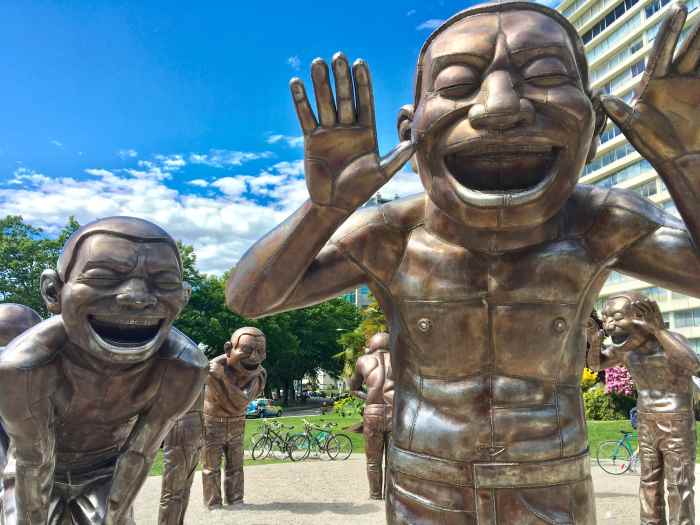
A close-upwards view of a character in "A-maze-ing Laughter"
Linda Crampton
Public Art Nigh Stanley Park
I savour observing public art in and around Vancouver. The area contains an interesting collection of sculptures. The four works shown and described in this commodity are located past the sea. This is not all that they accept in common. They accept been placed shut to Stanley Park, which is ane of Vancouver's major attractions. Combining an exploration of the park and the art is very enjoyable.
Identifying the principal entrance and go out of Stanley Park depends on the direction in which a person is walking. The A-maze-ing Laughter and Inukshuk sculptures are located in and near Morton Park close to the western entrance/get out of the park. The Search and Solo sculptures are located in Devonian Harbour Park by the eastern entrance/go out.
A walking and cycling path travels around the perimeter of the Stanley Park peninsula. An fine art lover can accept a short cutting from one of the sculpture locations to the other (points B and C on the map below) instead of travelling effectually the park. They may not want to take a short cut, though. The park contains additional fine art besides as other interesting sights. I frequently visit Stanley Park and nearby locations to take photographs, including the ones in this article.
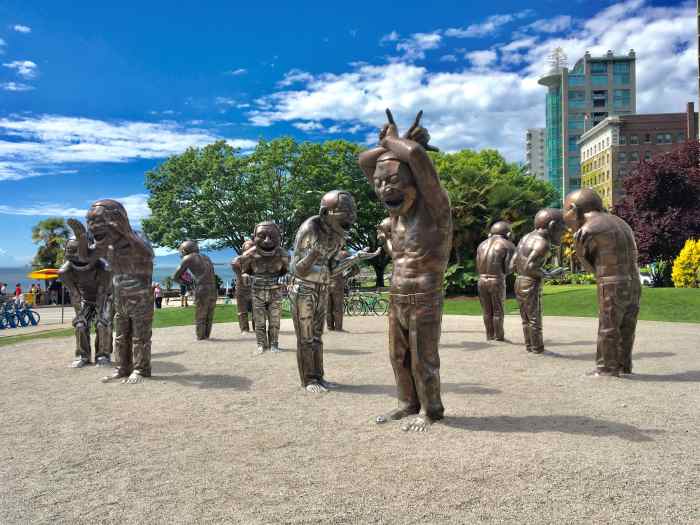
Part of the sculpture in Morton Park with English Bay in the background
The A-maze-ing Laughter Sculpture
Morton Park is a small neighbourhood park that tin be reached from a path abreast the ocean. The path passes by beaches, including English Bay Embankment, and then enters Stanley Park. Morton Park is very close to English Bay Beach and is located at the end of Denman Street. It can be reached past walking along Denman Street from downtown Vancouver or by taking a bus.
The figures in the A-maze-ing Laughter sculpture are around ten anxiety tall. They take big, open up, and grinning mouths with numerous teeth, and their eyes are closed. They appear to detect something hilarious. Virtually are aptitude over, obviously in laughter. The sculpture is a very popular place for the public to accept photos. People like to stand in front of a figure and mimic its pose as their photograph is taken.
The 14 figures were meant to exist a temporary exhibit. Thanks to a large and generous donation from a wealthy family and the sculptor's decision to sell his work for a reduced price, A-maze-ing Laughter became a permanent fixture in Vancouver. The inscription shown below has been written on a low wall behind the figures.
May this sculpture inspire laughter playfulness and joy in all who experience information technology.
— Inscription behind the A-maze-ing Laughter sculpture
The Artist and His Groundwork
The sculpture was created past a Chinese artist named Yue Minjun and was installed in Vancouver in 2009. The figures represent the artist. In that location has been speculation well-nigh the original intent of the sculpture because of the groundwork of the artist and his piece of work.
Yue Minjun'southward creations are associated with an fine art motility known as cynical realism. The move has been linked to pupil protest in China, including the 1989 events at Tiananmen Square. The artist has said that his mood changed at that fourth dimension and that he became "very down". He has also said that a smile doesn't necessarily hateful happiness and that information technology can sometimes signify something else. He has used a grinning caricature of his face in both paintings and sculptures, which sometimes have a serious theme. The smile character that he created is oftentimes shown multiple times in a single piece of work.
An commodity from the City of Vancouver's website has an explanation for the apparent modify in meaning of the sculpture. The article says that the choice of Morton Park for the sculpture's dwelling house stimulated "a rethinking on the part of the creative person about how this work could reverberate the site and be responsive to western order, exterior the political concerns and religious credo of Mainland china". A link to the article is provided in the "References" section below.
I don't know how the artist originally bundled or planned to arrange the figures. In the photos of Minjun's piece of work that I've seen, the grinning characters are arranged in lines or tight groups. In Morton Park, they have been placed in a maze-similar blueprint. They are spaced out and are facing multiple directions. The system enables people to walk amid the figures and notice them closely, which adds to the fun of a visit. I've seen occasional reports of people resenting the fact that the sculpture is being presented as fun without an acknowledgement of another possible pregnant.
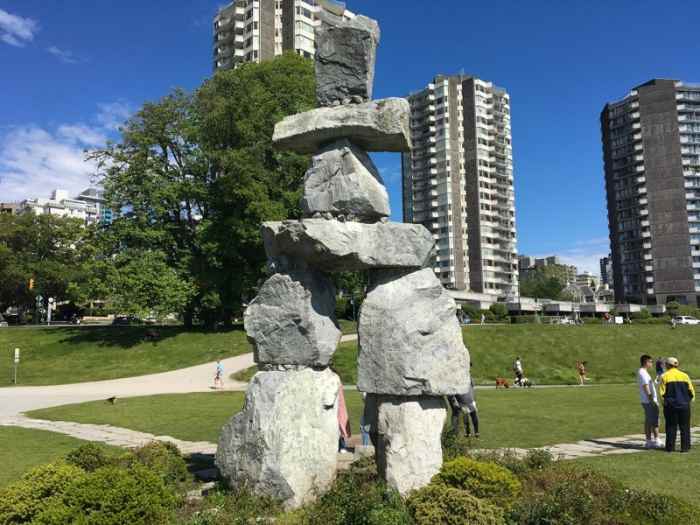
"Inukshuk"
Scroll to Continue
Read More from WanderWisdom
The Inukshuk and Its Function
An inukshuk or inuksuk is a construction associated with the Inuit people of the Canadian Arctic. It's made of stones and is utilitarian. It has the ability "to act in the chapters of a homo", every bit the word inuksuk is said to mean. An inukshuk in one case acted as a communication device for the Inuit, carrying information to beau travellers. The shape and form of an inukshuk indicated a practiced identify to find prey, a site where food had been hidden for future use, or a danger in the path alee, for instance.
An inukshuk was created from nearby rocks and stones. These were placed in a sculpture formation without any means of attachment except for their shapes and relative positions. I assume that the constructions present in tourist areas today contain stones that are attached by additional means to help ensure safe.
Even today when the Inuit have modern means of travel and communication, the inukshuk has cultural importance. The sculpture overlooking English Bay has the title Inukshuk and was created by Alvin Kanak. Information technology was commissioned by the Northwest Territories for their pavilion at the Expo 86 exhibition in Vancouver. Information technology was later given to the urban center as a gift.
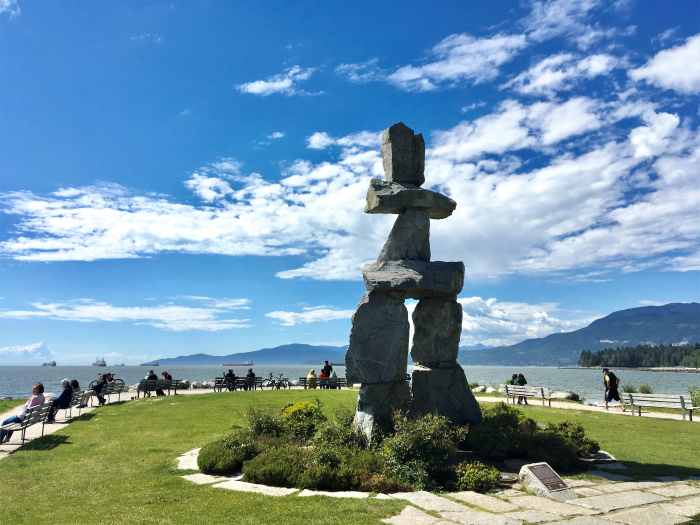
A view of the inukshuk from the opposite side
An Incorrect Name and an Innunguaq
Though a stone sculpture with a shape resembling a human is often called an inukshuk exterior of the Arctic, that'south not its correct name. The correct term is innunguaq, which means "in the likeness of a human being". The sculpture was symbolic rather than utilitarian. According to The Canadian Encyclopedia, it may have been used to point that humans gathered in a item expanse. Inuksuit (the plural of inukshuk) did exist and were used to convey useful information as described higher up, but they didn't resemble a human being.
It'due south understandable that the misuse of the word inukshuk might be irritating for some people. Unfortunately, the word is widely used outside of the Arctic. The correct term isn't as widely known. Another trouble is that the name given to the Vancouver sculpture by its creator is Inukshuk and can't exist arbitrarily changed.
In the video below, an Inuit cultural activist named Peter Irniq explains the difference between the terms inukshuk and innanguaq. Irniq is an artist who is currently known every bit Piiter Irnik. He has been politically active and has served as the commissioner of Nunavut, which is the most northerly territory in Canada. Information technology separated from the Northwest Territories in 1999.
The sculptures described in a higher place are located by English Bay, which faces the Strait of Georgia. The strait is located between mainland British Columbia and Vancouver Island. The sculptures described below are located by a more than sheltered ocean inlet on the other side of the Stanley Park peninsula.
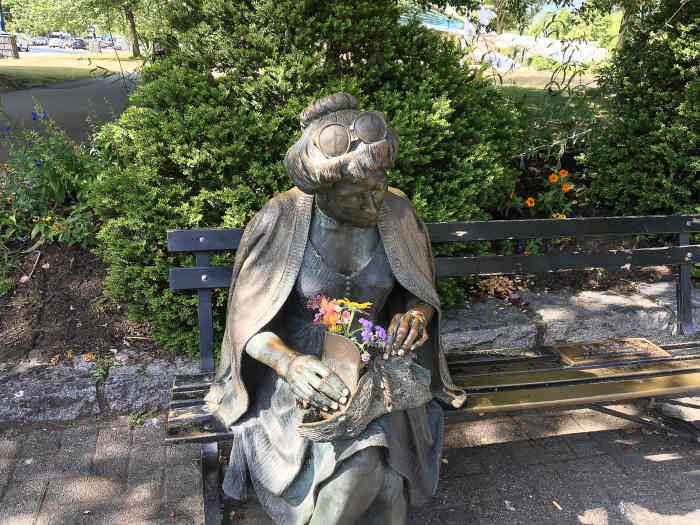
"Search" past J. Seward Johnson Jr.
The Search Sculpture
Devonian Harbour Park contains large lawns, flowers, trees, a pond surrounded by plants, sculptures, walking paths, and seats. On ane side of the park is a harbour and on the other is a city road. The park is large enough to be relaxing, despite the presence of the route, which is separated from the park by a wide path. Devonian Harbour Park serves every bit an entrance to Stanley Park.
The lady in the Search sculpture sits on a park demote not far from the road. She is searching in her pocketbook for something. Since she appears to be holding a case used to store glasses in her right hand, we can guess that she's searching for her spectacles or sunglasses. She seems to take forgotten that she's placed them on her head.
When I laissez passer by the lady on my style to Stanley Park, I frequently find that someone has placed a bunch of flowers in the open spectacle case, as in my photos. They've probably picked the flowers from the displays in the park, which is technically non allowed. It does create a squeamish splash of colour, though. People like to sit abreast the lady while their photo is taken.
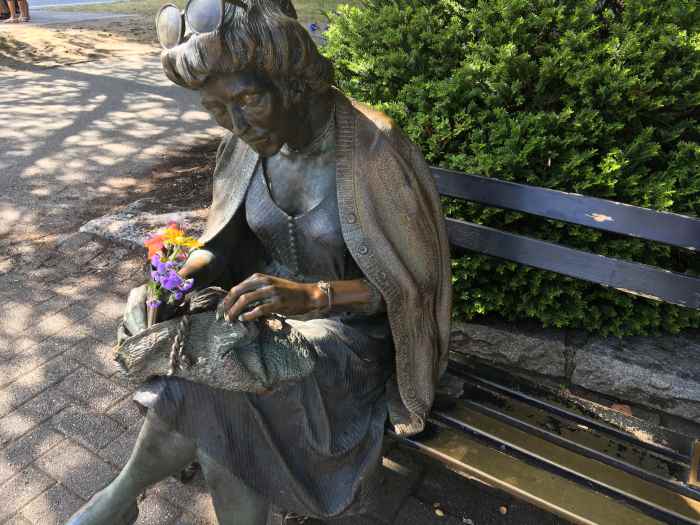
Another view of the bronze lady
Facts Near J. Seward Johnson Jr.
The sculpture of the searcher is made of bronze and was created by J. Seward Johnson Jr. He also created the popular Photo Session sculpture in Queen Elizabeth Park. The artist was built-in in 1930 in New Bailiwick of jersey and died in 2020. He'due south sometimes known as John Seward Johnson Jr. or equally Seward Johnson. He's known for his sculptures of ordinary people performing common activities as well as other works.
According to the Urban center of Vancouver's web page nearly the Queen Elizabeth Park sculpture, the artist started his cosmos of a human effigy with a clay model showing the desired pose. He then created a plaster model based on the face and body of a human being posed in the desired position. Clothes were sewn into the plaster and stiffened with resin. Farther models were created and improved until the final casting in bronze. This detailed process likely contributed to the realism of the models and their clothing.
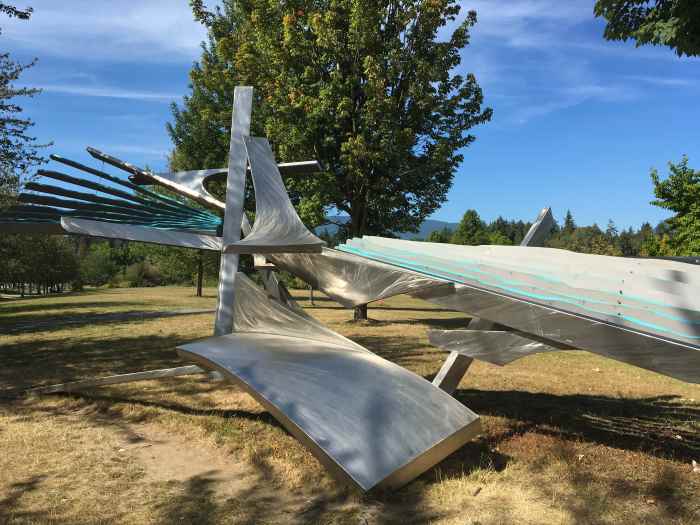
Role of the Solo sculpture
A Sculpture in Devonian Harbour Park
Solo is an abstract sculpture created by Natalie McHaffie. Information technology was installed in Devonian Harbour Park in 1986 as part of Vancouver's centennial celebration. The sculpture is made of stainless steel and painted cedar planks. The artist has reportedly said that the sculpture represents move simply not flight. She's a licensed pilot, so an association with flight might have been assumed by some viewers of the sculpture. This is peculiarly truthful because of the sculpture's name and considering it appears to comprise wing-like structures. I tin't become flying out of my mind when I view the work.
When the sculpture was first commissioned, at least ane person on the Vancouver Park Board was unhappy. They felt that a metal sculpture wasn't suitable for a natural area. Their objections were overridden, even so. My favourite aspects of the sculpture are the the coloured "feathers" of the wings and the light patterns created on the metal.
Facts Near Natalie McHaffie
Natalie McHaffie is an artist, writer, and onetime stunt flyer from Ontario. She teaches sculpture and has been associated with diverse museums and heritage sites. She's currently associated with the Not bad War Flight Museum in Ontario and appears to accept a deep love of planes.
The 2016 restoration shown in the video above was approved past the sculptor. Later on thirty years of being exposed to the elements, repairs were needed. The "25in25" reference in the title of the video refers to a public art retrospective that covered 25 years—1991 to 2016.
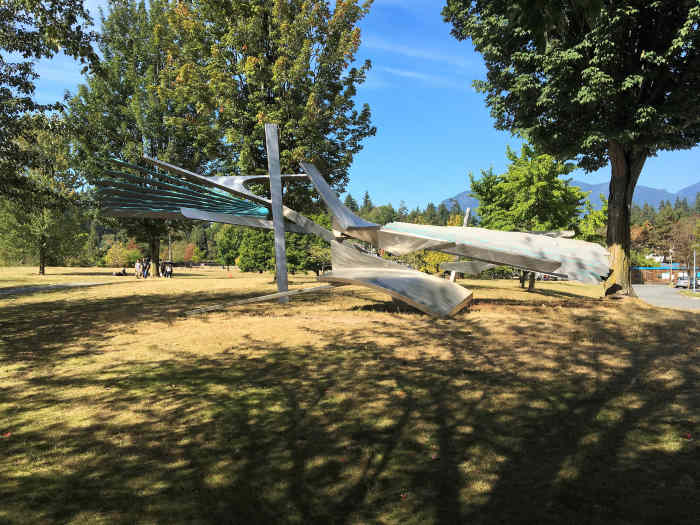
A view of the entire sculpture
Exploring Public Art in Vancouver
I relish exploring Vancouver by visiting public art displays and their environs. The activity could be a good way for a start-fourth dimension visitor to Vancouver to explore the city as well. The fine art can exist found in the downtown area and in various neighbourhoods in the city. New works announced quite frequently.
The public fine art section of the City of Vancouver'due south website is useful. It describes some walks that people could accept to run across street art and sculptures and also provides the latest news related to public art in the metropolis. Going on art walks and thinking about the meaning of the items that are seen can exist very interesting.
References
- A possible significant of Yue Minjun's sculpture from the National Post newspaper
- Cynical realism and Yue Minjun facts from the Encyclopedia of Art Education
- A PDF brochure about the A-maze-ing Laughter sculpture and the artist from the City of Vancouver's website
- Facts nearly the inukshuk or inuksuk from The Canadian Encyclopedia
- Piita Irnik information from The Canadian Encyclopedia
- Facts about Seward Johnson from Grounds For Sculpture (a sculpture park)
- A description of the creation of a J. Seward Johnson Jr. figure from the City of Vancouver'due south website
- Information about the Solo sculpture and Natalie McHaffie from the Vancouver Public Fine art Program
© 2019 Linda Crampton
Source: https://wanderwisdom.com/travel-destinations/Public-Art-by-the-Ocean-Vancouver-Statues-and-Sculptures
Belum ada Komentar untuk "Callums Sculptures Are So Cool Its Scarysee More of His Art Httpcbcca14201512"
Posting Komentar