Is the Modern Wing Og the Art Institue of Chicago Postmodern

1/5 Every bit with his other American museums, light and space are Piano'due south dominant themes, realised in taut refined structures that fuse craft and engineering science. A new footbridge links his Modern Wing with Millennium Park, locking the edifice more than intimately into the city

ii/5 Gallery block and new courtyard seen from Griffin Courtroom, the spinal concourse
iii/five The top-lit, axial concourse unifies the edifice

4/v A typical gallery space

5/v The concourse is a new gathering place
Renzo Pianoforte'south rational answer to Frank Gehry'sexuberant Jay Pritzker Pavilion. Photography by Nic Lehoux
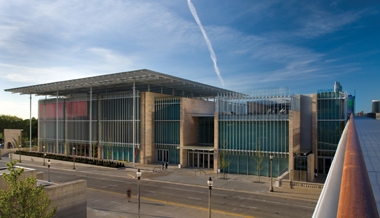
Few contemporary architects have such a stiff commitment to purpose and place as Renzo Piano. Each of the eight U.s. museums he has congenital or extended, from The Menil Collection in Houston (AR March 1987) to the California University of Sciences in San Francisco (AR November 2008) is shaped by context and programme. The newly completed Modern Wing of the Art Institute of Chicago is no exception. It comprises 2 blocks of galleries extending north from earlier additions to the Beaux Arts original, linked by a skylit concourse and shaded by aluminium blades set into a lofty white steel canopy. Limestone from the same quarry equally the 1893 block clads the side walls, and a double glass curtain wall to the due north dissolves the mass.
'It was a privilege to build in Chicago,' says Piano. 'It's a place of myth for me. As a immature architect I saw information technology as the city that reinvented itself after the peachy burn, using steel balloon frames to create buildings that were calorie-free and vibrant. It invented modernity, and my buildings endeavour to connect with that legacy.
'Relics of Louis Sullivan'south Chicago Stock Exchange, preserved abreast and within the art institute, are tangible reminders of the city's modern origins. Survivors from the first generation of principal-builders are cherished landmarks, equally are the urbane towers of Mies van der Rohe. But those are scattered highlights. Most recent structure is equally bland as in any American city, so Piano's addition is a welcome return to the principles that sustained the myth. Information technology conducts a dialogue with history and with arts and mural middle Millennium Park to the north.
When Frank Gehry completed the Jay Pritzker Pavilion - a baroque swirl of steel plates enclosing a concert beat - he issued a friendly claiming. 'Come and get me,' he told Pianoforte, who was finalising his pattern. The Italian did only that, exploiting the rigorous street grid to marshal his concourse on the pavilion, counterpointing Gehry'due south exuberance with his absurd rationality. 'He works in his language, I with mine, but the two projects do a similar task,' says Pianoforte. 'He created an acoustical space and we created a visual space protected from the sun.' To tie the two together, a slender 180m-long footbridge slopes gently downwards from a rooftop sculpture garden to the eye of the park, complementing the equally graceful span that Gehry designed to link landscape with lake shore.
All this might have turned out differently merely for a serendipitous encounter. Equally Piano recalls, 'I was in Chicago in 1999 and James Woods, the Fine art Constitute manager, invited me to stop by. A number of people came and we had a very informal conversation almost their plan to expand. Later I understood that was the selection process. I like it when in that location is an exchange of ideas. Competitions are too oft like beauty contests.
'Initially, the goal was to add galleries on the south side, as the largest of seven successive additions to the original building. By late 2001, information technology was clear that Millennium Park was condign a new centre of activity. The Goodman Theatre facing the park across E Monroe Street had relocated and the institute was able to learn and demolish its former building. That provided a larger, more prominent site, with the opportunity to create a assuming cross axis that would bring a sense of order and connectivity to a muddled east-west sequence. As Piano observes: 'The erstwhile galleries offered an incredible place to view fine art just people got lost easily.' The desire to span a busy street led to the idea of a sloping promenade, accessible to the disabled, which would describe people in from the park. As graceful in its profile as the hull of a skiff, the footbridge doubles equally a belvedere offering a panorama of the city and every bit another point of entry.
The transparency of the north facade turns the axial concourse named Griffin Court into a public gathering place, alive with school parties using the educational centre to the eastward and visitors to the store and temporary galleries on the due west side. The shallow pitched skylight is cable-braced similar the rigging of a ship.
Pianoforte believes that museums need to remainder sacred and profane space, and the bustle of the ground floor gives way to the serenity of the galleries for modern and contemporary art on the two upper levels. 'You "take your shoes off" and you go up - it'south a unlike world,' says the builder.
There's a seamless link between the white oak floors and benches. On the height flooring, you tin can glimpse the sky through the awning that projects beyond the building and the thin fabric that filters the light. The blades are calculator controlled to respond to fluctuations in the intensity of light and photovoltaic cells in window scrims conserve energy. An exemplary drove of modern classics from the first half of the 20th century is suffused in natural light. On the level below, contemporary art and the rich collection of pattern and architecture are displayed in galleries that flow into each other and describe natural lite from windows and the concourse. An encyclopedic museum that has nerveless contemporary fine art since it was founded 130 years ago, now the full sweep of the found'southward holdings is finally on view.
The grandeur and intimacy of the galleries matches the engaging presence of the outside. 'For me, a building never stands alone. It'south a piece of the metropolis,' says Piano. He has woven the Modern Wing into the fabric of a heroically scaled city as successfully as he accommodated The Menil Collection to the scale and character of its residential neighbours. The new structure is rigorous simply welcoming - a measure of quality and relevance for Chicago, where the guiding vision was eclipsed for several decades. It besides provides a subtle riposte to the overheated, ego-driven world of museum design.
2009-07-01
July 2009
Source: https://www.architectural-review.com/today/art-institute-of-chicago-by-renzo-piano-building-workshop-chicago-usa
Belum ada Komentar untuk "Is the Modern Wing Og the Art Institue of Chicago Postmodern"
Posting Komentar